
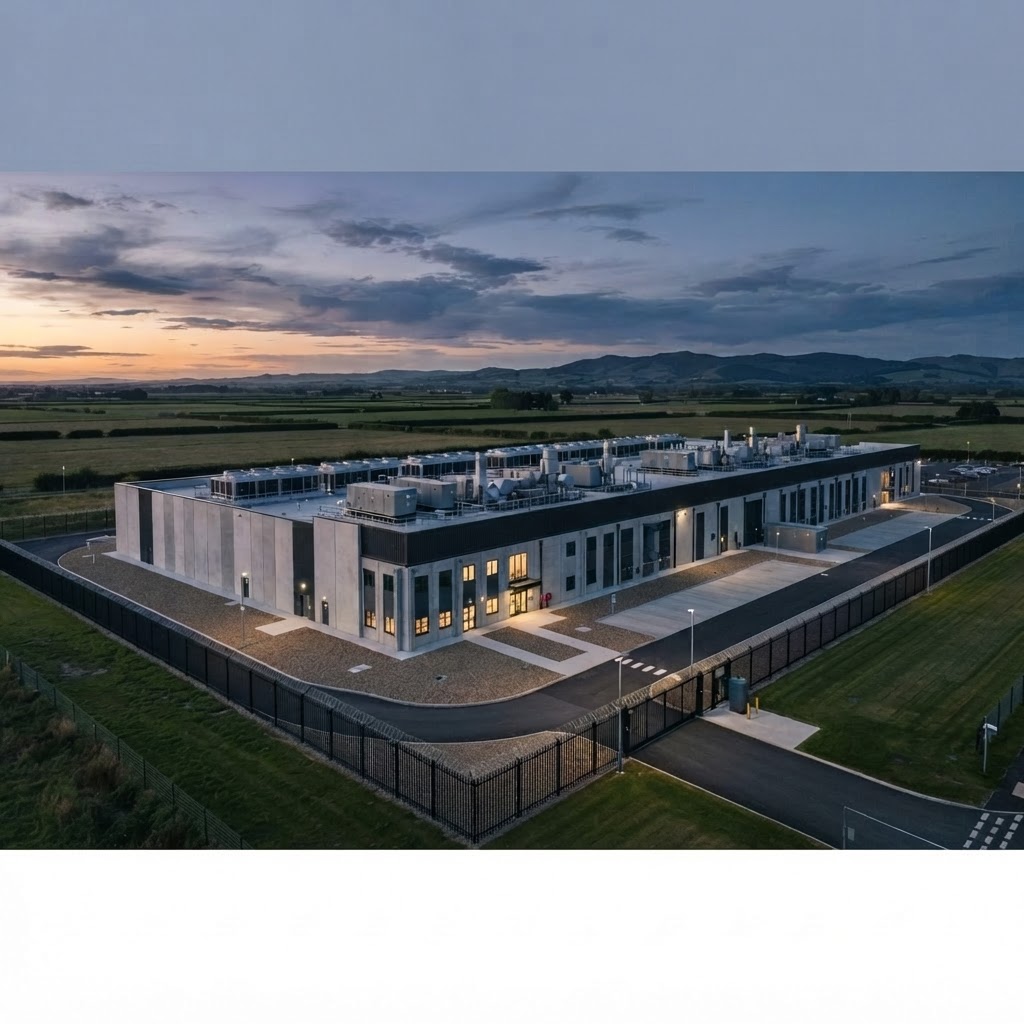
If you live in a small or mid-sized county, there's a decent chance a data center proposal will land on your local planning agenda sometime in the next few years — if it hasn't already. What used to be a big-city or specific-corridor phenomenon (Northern Virginia, parts of Texas, the Pacific Northwest) has spread into rural and suburban counties across the country, driven by rising demand for cloud computing and AI infrastructure.
Whether that's good news or bad news for a given community depends heavily on the specifics — the site, the utility contract, the tax structure, and how the approval process is handled. Here's a neutral rundown of what data centers actually are, why they're showing up in smaller towns, and what tends to matter most in the local approval process.
What is a data center, exactly?
At its simplest, a data center is a large building full of computer servers — the physical infrastructure behind cloud storage, streaming, online banking, and increasingly, AI processing. Modern data centers range from a single warehouse-sized building to sprawling "campuses" of multiple structures on hundreds of acres.
They're typically low-employment relative to their size and cost. A large facility might represent a $500 million to multi-billion-dollar capital investment, but employ only a few dozen to a couple hundred permanent staff once built — most of the jobs are during construction.
Why are they moving to smaller counties?
A few converging factors:
- Land and power availability. Large metro areas have run short on the cheap land and, more importantly, the electrical grid capacity these facilities need. Smaller counties often have both.
- Tax incentives. Many states and counties offer sales tax exemptions on servers and equipment, or property tax abatements, specifically to attract data center investment.
- Fiber and grid proximity. Counties near major transmission lines or fiber routes become attractive even without other big draws.
- AI-driven demand. The recent surge in AI infrastructure buildout has accelerated the pace and scale of proposals well beyond historic cloud-storage-era levels.
What communities tend to weigh in the debate
Coverage of data center proposals across the country tends to surface the same handful of issues, on both sides:
Commonly cited benefits:
- Substantial one-time construction spending and temporary construction jobs
- New property tax or negotiated payment-in-lieu-of-tax (PILOT) revenue for the county or school district
- Infrastructure upgrades (roads, substations) sometimes funded or cost-shared by the developer
Commonly cited concerns:
- Water use. Many data centers use water for cooling, which can strain local supply in drought-prone or already water-stressed areas. Some newer designs use closed-loop or air-cooling systems that reduce this significantly — it varies a lot by facility.
- Electricity demand and rates. A single large data center can use as much power as a small city. Communities and utility regulators in several states have raised questions about who ultimately pays for the grid upgrades this requires — the developer, or all ratepayers.
- Noise. Backup generators and cooling equipment can run continuously and have drawn noise complaints in some communities.
- Limited permanent jobs relative to investment size, compared to other types of large developments.
- Visual and land-use impact of large industrial-scale buildings in previously rural or low-density areas.
None of these concerns apply uniformly — they depend on the specific project, the local water and power situation, and the terms negotiated with the developer.
What to check if one is proposed near you
If a data center proposal shows up on your county's agenda, a few questions tend to matter most:
- What's the water source and projected usage? Ask whether the facility uses evaporative cooling (higher water use) or a closed-loop/air-cooled system (lower water use).
- Who pays for grid upgrades? Look for whether the developer is covering interconnection and infrastructure costs, or whether those costs could be spread across other ratepayers.
- What's the tax agreement? Many of these projects come with negotiated abatements — it's worth understanding what the county is giving up versus gaining, and over what time frame.
- What's the zoning path? Some proposals go through as permitted industrial use with minimal public hearing; others require a conditional use permit or rezoning, which comes with a formal comment period.
- Is there a decommissioning or reuse plan? Server technology cycles fast; it's reasonable to ask what happens to the building in 15–20 years.
The bottom line
Data center proposals aren't uniformly good or bad for a community — they're a trade-off whose terms are set project by project, often in negotiations that aren't very visible until a public hearing is already scheduled. The communities that tend to come out of the process satisfied, on either side of the debate, are usually the ones that engaged early — before the zoning decision, not after.
That's the gap CountyWatch is built to close: surfacing these proposals when they first hit your county's docket, not after the vote.